Cruelty of the 1930s and The Effects That it Had it on Everyday Americans
In the image you can see a woman holding her baby and her two child sleeping on the ground beside her. The children male nourished and like they don’t have a home you can probably say this image was taken during the great depression. The first thing I notice is how depressed the woman is and the fact that her children don’t have pants. The image is arranged with woman holding a baby leaning against a door and her son on the right and her daughter on the right. The physical setting looks like they are outside a church and the imagery is very dark. It can also be interpreted as being very depressing. The feet of the children are very dirty and don’t have shoes. The clothes that this family is wearing is ripped something that I did not noticed before is the fact that it looks like the children ripped a part of their clothes to sleep on. I don’t for sure if the image takes place outside a church, but that is the only place I know it is safe for poor people to sleep in with having problems with cops because of the separation of church and state. The image is black and white which makes it look gloomier and sadder and adds a new effect to the image when you look at it. The photographer looks to be the same level as the subject he is taken a picture of. The vantage point helps us get a clearer look at the image and be able every detail the image has to offer. The photographer wants us to see the destitute and poverty that people in the 1930 had to offer and how difficulty it was for families to survive and have a home to sleep at. Tuesday, January 28, 2014
Monday, January 27, 2014
clothes=problems

During the depression it wouldn’t be uncommon to see a sight
like this. Hanging clothes on lines outside of apartment buildings isn’t
something one would think twice about. However, this photograph shows exactly
what the depression was doing to people. If you start from the top you notice
that there’s no clothes and as you go down the building the load of clothes
gets larger and larger. This depicts the weight of the depression on the
classes of America.
If one is
on the top earnings of classes, the highest on the clothing line, they have
little to no weight on their shoulders. They are slightly affected by what’s
going on. The middle class has more clothes and more worries as depicted in
this photo but the people with the most clothes and the most worries are those
who live on the lower levels of the apartment. This represents the lower class
of America. Those in the lower class during the great depression were literally
living with the world smashing on top of them. They had all the worries in the
world even though they could do nothing about it. They had to have hope in
those in the classes above them although the classes above them didn’t truly understand
what they were going through.
Those living
in the upper classes don’t know what it’s like to have to wash and hang so many
clothes. They don’t know what it’s like to live on less than a dollar a day. Therefore
they have no urgency to change things. They don’t have as many things wet
therefore they don’t have to spend as much time drying them. So although those
on lower end of the apartment had more problems they had very little control
over their circumstance and had to depend on those above them.
Children In The Early 1900s

In this photo we have a group of kids that look to be from the age 5 to 10 or 11. I believe what the photographer, Walker Evans is trying to capture in this picture, is the point of view of the children during the Depression era. Being children, I'm sure they didn't gather everything that was happening and most of the things that was wrong. Sure they knew that something was going on with the economy, but few knew what was actually going on during this time. They didn't know the struggle of getting a place to work on a daily basis. They didn't know how hard it was to get food. They didn't know how sick people got, and they didn't know the true pressure that adults and elders had when it came to worrying about if they were going to be living on the streets the next night. Even in this photo, you have kids who appear to just be playing and sitting on the porch steps of an apartment home, but if you take a closer look at the children's faces, they do seem a bit worried about something. It could just be that it's a hot day, or it could be that they are getting there picture taken, but I believe the looks on their faces hold some kind of deeper meaning to them. This is how you know that it wasn't just adults worried, that the adults worries rubbed off on the children. Ever heard that saying, "If mom's unhappy, the kids are unhappy." I believe that applies in this case as well with these children.
The Vernacular: Street Life Architecture

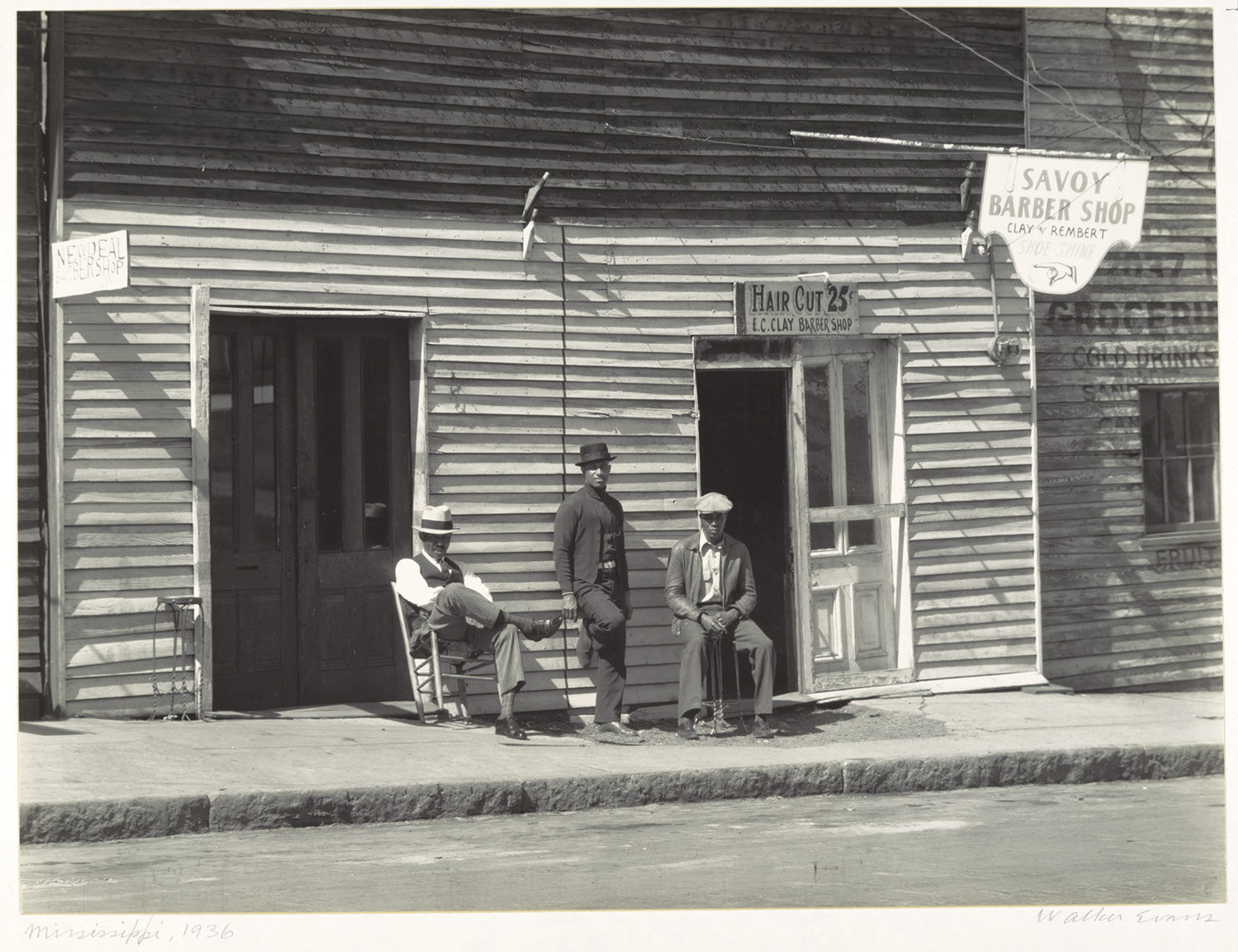
Walker Evans was known for his collection of roadside architecture. In this photograph we see three gentlemen standing outside of a barbershop in Vicksburg, Mississippi. The barbershop is used to depict local street life. Evans believed the local barbershop was an expression of the African American community. Walker Evans saw areas like the barbershop as a meeting place where gossip and other talking among community members took place. Upon closer examination of the photograph the men can be seen waiting for their customers outside of the barbershop on a cool winter's day. My interpretation upon first glance at the image makes me believe that the employees of the barbershop are taking a hit on their business because of the great depression impacting people everywhere and is making life harder for businesses everywhere. In my opinion it was Evans' intent to make the audience feel the struggle of the business and businesses everywhere in the United States. The emptiness of the street indicates that the barbershop was not the only place taking damage from the fall out of the stock market crash. I looked at the photos taken by Walker Evans by my fellow group members and saw many photos similar to my own. Most of Walker Evans' photos are of other people or areas located on the street. The most common feature of all the photos is a sense of despair among people during the great depression as well as buildings being run down or closing. What I myself have taken away from examining Walker Evans is that while most people were dramatically impacted by the stock market crash. However, even though the future looked grim people carried on with their lives because the world never stops turning and showed determination in the face of one of the worst times in American history.
Worry During the 1930's
In the image I chose you see a close up of a man. He looks as if he is sitting down and his hands are on his face. The first thing I noticed about the picture was that the man has his hands on his face and it looks like he is biting his nails. Usually when people do this, it means they are worried or stressed out about something. This could be seen as a theme for the era at the time. People were probably worried and stressed about the economy, their jobs, and how they were going to make ends meet during the Great Depression. Also, I noticed the man has a tissue or maybe a handkerchief in his hand that's been crumbled up in a ball. This could mean he was crying before which could be a result of the stress and worry he has been feeling. You see in the background there could be some sort of machine but it is not the main focus of the picture because it is blurry. This could mean that the photographer was really trying to emphasize the people and their emotions during this time. This photo is in black and white which makes it seem very depressing and sad. The photographer seems to be on the same level as the subject, making it seem as though he might have been in the same boat as the man. I think it would've been different if the photographer took the photo at a higher vantage point because to me that would've symbolized dominance or that he was better off than the man. I think the main mood of this picture is worry. I feel like in other historical documents about the 1930's you mostly hear about economically how the nation was doing, we never really learned about how the people of the 1930's felt. We knew it was a hard time but I think the photographer wanted us to see the different moods of different people in this era.
Americans Distraught and Gloomy

Walter Evans photographed this photo of a tenant on East Sixty- First Street, probably between First and Second Avenues. He photographed an older man sitting on a doorstep outside an unknown building. With him being a tenant, probably his residence. The first thing that came to my mind when I glanced at the photo was distraught. An old man sitting on a door step, staring at the ground as if he is in some state of shock. He remains calm, eyes wide, and bewildered. If you look deep in the eyes of the old man, even though he isn't looking at the camera, you can feel the pain and worry that fills him inside. He is old and grey and still has so much weight on his shoulders. One wrong turn or mishap, changes everything. In the late 1920s and early 1930s disappointment, worry, and sadness filled the people of the streets on a daily basis. Evans wanted his audience to see an example of just that; the distress and uneasiness that comes along with change and 'Self-Help in Hard Times.' My interpretation of the photograph and caption, is that this poor tenant probably couldn't afford to stay any longer. One aspect of this image that might not get noticed at a first glance is how the person leaving the door is behind him. This could be interpreted in a few ways, but my thought is that it represents that all of the hard times are behind you. The man who is taking his residence and forcing him on the street is one bump in the road. It is behind him. In that day, in order to survive you didn't have time to weep and sulk in your own misfortunes; you had to keep moving forward. Overall, the mood is gloomy. The man has just been mentally and emotionally beaten down without ease. He sees no light at the end of the tunnel, even though there could be.
Subscribe to:
Posts (Atom)